🟣 General Introduction to the Book and Its Purpose
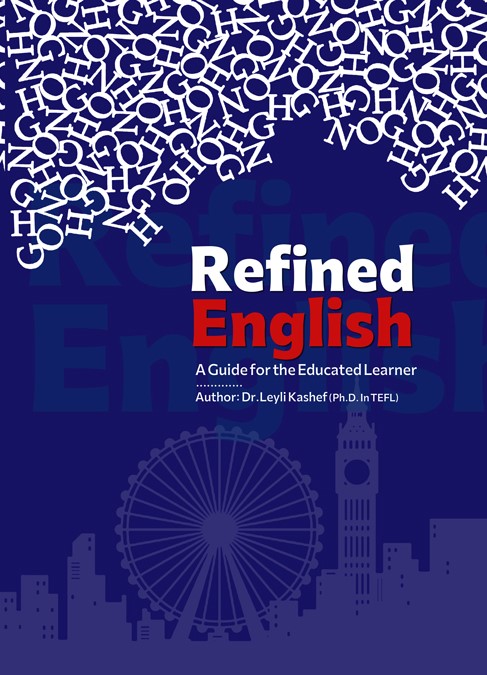
Refined English: A Guide for the Educated Learner, written by Leyli Kashef and edited by Nasim Naserimoghadam, is an educational and stylistically oriented work designed for learners who already possess a foundational command of English but wish to elevate the quality of their expression. Rather than focusing on elementary grammar or basic language acquisition, the book is intended for readers who seek greater precision, elegance, and refinement in both spoken and written English.
The main purpose of the book is to help educated learners move beyond ordinary correctness toward a more polished and sophisticated use of language. It seeks to develop not only vocabulary and grammar awareness, but also stylistic sensitivity, clarity of thought, and the ability to choose language appropriately for academic, professional, and literary contexts. In this sense, the book functions as both a language guide and a tool for intellectual and rhetorical refinement.
A notable feature of the book is its emphasis on the relationship between language and thought. It presents refined English not as decorative language, but as a disciplined form of expression in which clarity, elegance, and precision work together. The reader is encouraged to see English as a living art—one that can sharpen communication, strengthen argumentation, and enhance self-expression.
This book is especially useful for students, university learners, teachers, researchers, and educated readers who wish to improve their academic writing, formal speech, and overall command of sophisticated English.
🟣 Summary
The structure of the book is carefully arranged to move the reader step by step from grammatical foundations to advanced academic and stylistic expression. Its content can be summarized in several major sections:
Section 1: Core Tenses and Foundational Grammar
The book begins with a review of essential English tenses, including the present simple, present continuous, past simple, present perfect, future forms, past continuous, past perfect, future perfect, and conditionals. These lessons are paired with refined vocabulary and integrated practice so that grammar is not learned in isolation, but within meaningful and elevated contexts.
Section 2: Advanced Grammar and Sentence Control
In the next part, the learner is introduced to more complex grammatical structures such as passive voice, mixed tenses, advanced review forms, and complex sentence patterns. This section helps the reader gain greater control over sentence structure and use language with more flexibility and sophistication.
Section 3: Academic Style and Formal Writing
A major portion of the book is devoted to academic writing and formal expression. Topics such as reported speech, modal verbs, linking devices, cohesion, nominalization, contrastive language, cause and effect, comparison and similarity, emphasis, summarizing, persuasion, evaluation, and hypothetical language are presented in a practical and structured way. This section is especially valuable for developing a more scholarly and professional tone.
Section 4: Precision, Clarity, and Rhetorical Development
The book further explores language functions that are essential in academic and formal communication, including definitions, exemplification, sequencing, clarification, concession, objectivity, balance, reinforcement, limitation, expansion, and elaboration. These lessons help the learner write with greater logical organization and rhetorical control.
Section 5: Formal Academic Discourse
In the later lessons, the focus shifts toward more advanced forms of academic discourse, including formal comparison and contrast, cause and effect, hedging and probability, summarizing and restating, transitions, closure, and argumentation. At this stage, the reader is trained to produce language that is measured, refined, and contextually appropriate.
Section 6: Consolidation and Final Review
The final lessons provide formal review and synthesis of the book’s main language functions, along with exercises that test the learner’s command of connectors, vocabulary, and short writing tasks. This closing section reinforces the book’s central aim: to transform grammatical knowledge into articulate, polished, and academically effective English.
Overall, Refined English: A Guide for the Educated Learner is more than a grammar book. It is a practical guide to writing and speaking with precision, elegance, and intellectual maturity. By combining grammar, vocabulary, style, and practice, it offers readers a pathway toward more refined and effective English expression.
توضیحات تکمیلی
قطع
وزیری
امتیاز دریافتی محصول از کاربران
متوسط امتیاز ها
0
220,000تومانقیمت اصلی 220,000تومان بود.200,000تومانقیمت فعلی 200,000تومان است.